Intelligent prospecting tools that book meetings do more than surface contact data. They combine deep research on each prospect, personalisation logic that reflects real buying context, and a clear path from first message to confirmed conversation. The tools that stop at contact discovery leave the hardest part of prospecting untouched.
The Gap Between Finding Prospects and Booking Them
According to Gartner's 2024 B2B buying research, the average B2B buying group now involves between six and ten stakeholders. That complexity means the value of any prospecting tool is not measured by the size of its database. It is measured by how well it helps you reach the right person with the right message at the right moment.
Most sales teams have access to prospecting data. LinkedIn Sales Navigator, Apollo, ZoomInfo, and similar tools give teams a starting point. The problem is that a list of contacts with verified email addresses is not a pipeline. It is the raw material for one. What happens between contact discovery and a booked meeting is where most tools, and most teams, fall short.
What Makes Prospecting Tools Genuinely Intelligent?
Intelligent prospecting tools go beyond filters and databases. A genuinely intelligent tool reads buying signals, understands prospect context, and generates outreach that reflects a specific reason to reach out rather than a generic pitch. The difference shows up in reply rates within the first 50 messages sent.
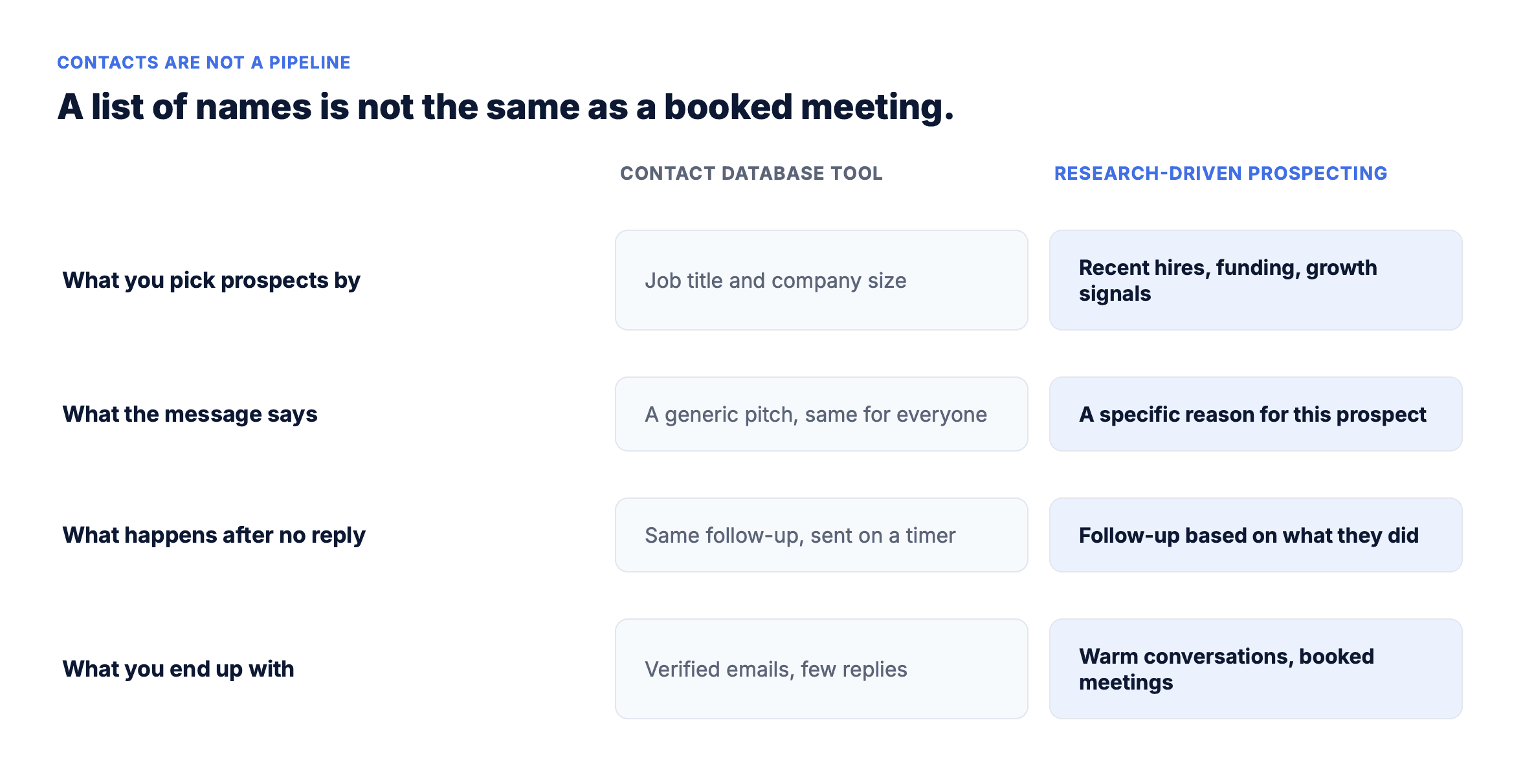
The most effective tools in this category do three things well. First, they identify prospects based on behavioural and contextual signals, not just firmographic filters. A company that recently hired a VP of Sales, closed a funding round, or expanded into a new market is in a different buying posture than a similar company that has been static for two years. Second, they generate messaging that reflects that specific context, not a template with a personalised opener bolted on. Third, they track engagement and adapt the sequence based on what each prospect responds to, rather than running the same cadence for everyone.
This is the logic behind the AI Twin we use at TheShowcase.ai. It researches each prospect individually, identifies the most relevant angle for outreach, and builds a message sequence grounded in that prospect's actual situation. Our human team then manages every reply, ensuring no conversation is handled by automation alone. You can see the full approach at
How Does AI-Powered B2B Prospecting Actually Work?
AI-powered B2B prospecting works by combining large-scale data processing with personalisation logic that would take a human researcher hours to replicate manually. The AI identifies who to target, why they are a strong fit, and what to say to them, based on signals that go beyond job title and company size.
In practice, this means the AI reads recent company activity, identifies role-specific pain points, and generates messaging that speaks to a specific moment in that prospect's business. A head of operations at a logistics company that just opened a new warehouse has different pressures than one at a company running the same routes it has run for a decade. AI that can identify and articulate that difference outperforms any static template.
According to LinkedIn's 2024 State of Sales report, 76% of top-performing sales professionals say that AI tools give them more time to focus on high-value interactions. The key phrase is high-value interactions. AI-powered prospecting tools free up human time for conversations, not for research and list-building.
What Separates Tools That Surface Contacts from Tools That Convert Them?
Tools that surface contacts give you a database and a sending mechanism. Tools that convert contacts into meetings give you a reason to reach out, a message worth reading, and a follow-up sequence that respects the prospect's time. The conversion gap between these two categories is significant and measurable.
The research depth behind each outreach attempt is the primary differentiator. A tool that pulls a contact from a database and assigns them to a generic sequence treats all prospects in the same industry as identical. A tool with genuine personalisation logic treats each prospect as an individual with a specific context. The second approach produces more replies, higher-quality conversations, and meetings that are already warm before a rep joins the call.
We have seen this pattern consistently across more than 200 campaigns run through our platform. Clients who come to us after using database-plus-sequence tools almost always report the same experience: decent contact data, poor reply rates, and a handful of meetings that do not convert. The missing layer is always research depth and personalisation logic, not volume.
For B2B companies operating in Sweden and the wider Nordics, this matters even more. Nordic decision-makers are direct, have a low tolerance for generic pitches, and respond well to outreach that demonstrates genuine understanding of their business. Our AI Twin is built to handle that level of specificity, and our human team manages every conversation from first reply to booked meeting.
Why Most Prospecting Stacks Fail to Produce Pipeline
Most prospecting stacks fail to produce pipeline because they add tools without adding intelligence. A company with Sales Navigator, Apollo, an email sending platform, and a CRM has a sophisticated-looking stack. But if the logic connecting those tools is a generic sequence built by a junior SDR, the output reflects the weakest link.
The tools are not the problem. The process is. Specifically, the absence of a structured research and personalisation layer between contact discovery and outreach is where most stacks break down. Buying a bigger database or adding another automation tool does not fix a personalisation gap.
What fixes it is a combination of AI that can process research at scale and humans who manage the relationships that result. That combination is not common in off-the-shelf tools. It is the model we have built at TheShowcase.ai, and it is why clients on our platform book between 15 and 30 qualified meetings per month without adding headcount.
Common Mistakes to Avoid
Choosing prospecting tools based on database size. Database size is the least predictive variable in outreach performance. A tool with 300 million contacts and generic sequencing will underperform a smaller tool with strong personalisation logic and good signal detection. Evaluate tools on the quality of outreach they enable, not the quantity of contacts they store.
Treating AI outreach as a set-and-forget system. AI-powered prospecting requires human oversight of every reply. Prospects who respond are entering a conversation, not a sequence. Handling those replies with automation rather than a human team is one of the fastest ways to lose meetings that were already within reach.
Skipping the signal layer and prospecting from static lists. A static list of contacts at target companies is a starting point. A list filtered by recent buying signals is a prioritised pipeline. Companies that prospect from static lists consistently see lower reply rates and worse meeting quality than those who incorporate behavioural and contextual signals into their targeting.
Measuring tool success by emails sent rather than meetings booked. Activity metrics are easy to generate and easy to misread. The only metric that matters for a prospecting tool is qualified meetings produced. Measure that number monthly and segment it by channel, sequence, and ICP to understand what is actually working.
Frequently Asked Questions
1. What are intelligent prospecting tools that book meetings?
Intelligent prospecting tools that book meetings combine contact discovery with buying signal detection, AI-driven personalisation, and a clear path to a confirmed conversation. They go beyond surfacing contacts to generating outreach grounded in each prospect's specific context. The result is a higher reply rate and meetings that are already warm before a rep joins the call.
2. How does AI-powered B2B SaaS prospecting work?
AI-powered B2B SaaS prospecting uses machine learning to identify ideal prospects from large datasets, detect contextual buying signals such as hiring patterns or funding activity, and generate personalised outreach at scale. The best implementations combine this AI research layer with human management of prospect conversations, ensuring that replies are handled by a person rather than another automated sequence.
3. What is the difference between a prospecting tool and a lead generation platform?
A prospecting tool focuses on identifying and reaching individual contacts who match your target profile. A lead generation platform typically encompasses the broader process of attracting, qualifying, and converting prospects into pipeline. In practice, the most effective B2B lead generation combines prospecting tools with personalisation logic and human-managed conversation handling.
4. Why do most prospecting tools fail to produce qualified meetings?
Most prospecting tools fail to produce qualified meetings because they stop at contact data and generic sequencing. The gap between a verified email address and a booked meeting requires research depth, personalised messaging grounded in a specific reason to reach out, and a qualification layer before any meeting is confirmed. Tools that skip these steps produce activity, not pipeline.
5. How many qualified meetings can AI prospecting produce per month?
With a structured AI prospecting approach that includes tight ICP targeting, signal-based personalisation, and human-managed conversation handling, B2B companies typically book between 15 and 30 qualified meetings per month. The range varies by market size and deal complexity, but the primary driver of meeting volume is outreach precision, not outreach volume.
See What Prospecting Built Around Research Depth Looks Like
Book a free consultation and see how our AI Twin and human-managed outreach process converts the right prospects into qualified meetings your team will actually close.
Added 03.07.2026