Qualifying B2B leads before the sales meeting means verifying that a prospect has the right company profile, budget authority, a live problem your product solves, and a reason to act now. Done correctly, pre-meeting qualification cuts no-show rates, shortens sales cycles, and ensures your closers spend every hour on conversations that can actually close.
Why Bad Qualification Kills Sales Performance
Most B2B sales teams lose more revenue to bad-fit meetings than to bad closers. According to HubSpot's 2024 State of Sales report, sales reps spend only 28% of their week actually selling, with the rest consumed by admin, research, and meetings that go nowhere. The problem almost always starts upstream, at the point of lead generation, not at the point of closing.
The pattern we see most often across outbound campaigns is straightforward: a company runs volume-based outreach, books meetings on any positive reply, and then wonders why the pipeline looks healthy but conversion to closed-won is low. The meetings are happening. The right meetings are not.
What Does a Qualified B2B Lead Actually Look Like?
A qualified B2B lead is a decision-maker at a company that fits your ideal customer profile, has a problem your solution addresses, and has both the authority and the urgency to make a buying decision within a reasonable timeframe. Qualification is not a single yes or no. It is a set of verified conditions that must all be true at the same time.
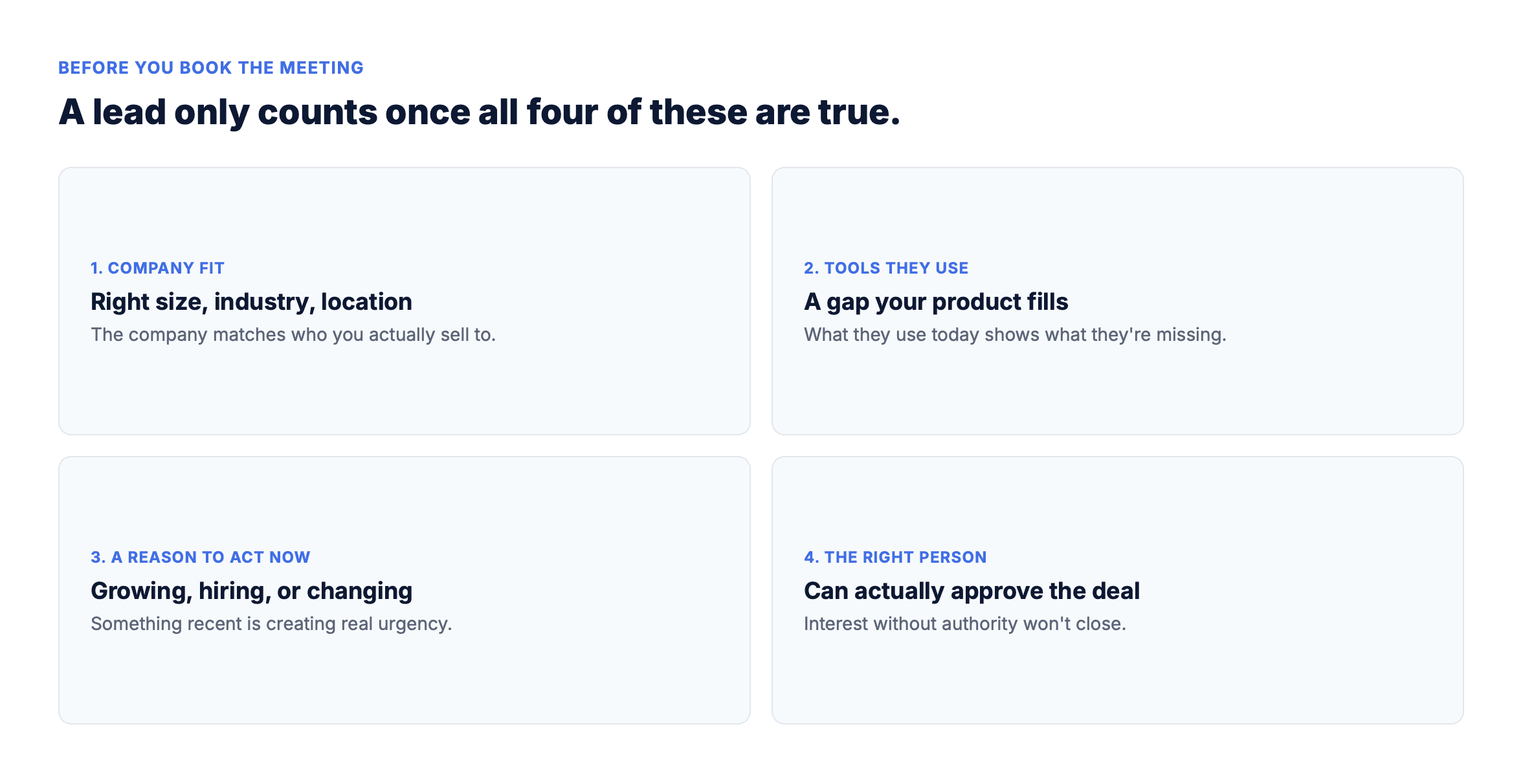
The framework most high-performing outbound teams use maps to four dimensions: firmographic fit (industry, company size, geography), technographic fit (what tools they already use), situational fit (are they growing, hiring, or in a transition that creates urgency), and stakeholder fit (is the person you are talking to the one who signs the contract, or do you need to get to someone else). Skipping any one of these dimensions is where pipelines get polluted.
We run this qualification layer before any message is sent. Our AI Twin cross-references firmographic data, hiring signals, LinkedIn activity, and technographic indicators to build a scored prospect list that only surfaces contacts who meet all four criteria. That research layer is what separates the approach at from campaigns that simply spray connection requests at a job title filter.
Why Does LinkedIn Outreach Turn Spammy?
LinkedIn outreach turns spammy because of three structural failures that compound each other: targeting that is too broad, messaging that is too generic, and follow-up sequences that ignore how the conversation developed. Each failure on its own produces mediocre results. All three together produce the kind of outreach that has trained buyers to ignore connection requests entirely.
Broad targeting is the root cause. When a campaign targets "VP of Sales" across an entire country with no further filter, the prospect list includes companies at completely different stages, with completely different tools, completely different budgets, and completely different problems. A single message cannot speak meaningfully to all of them. So the message gets written to offend no one, which means it resonates with no one.
Generic messaging follows logically from broad targeting. If you do not know enough about a prospect to write something specific, you write something safe. "I help companies like yours improve their sales process" tells a prospect nothing. It signals that you did not look at their company before reaching out, which tells them the product is probably not built for them either.
The follow-up failure is subtler. Most sequences are time-based, not signal-based. They send message three on day seven regardless of whether the prospect opened message two, clicked a link, or replied with a question. Signal-based follow-up, where the next message responds to what the prospect actually did, is what separates a conversation from a drip sequence.
How to Build a Research-First Qualification Process
A research-first qualification process starts with defining disqualifying criteria before defining qualifying ones. Most teams define what a good lead looks like. Fewer define what makes a lead immediately wrong, and that second list is what actually saves time.
Here is the structure that works across the outbound campaigns we run:
Define the ideal company profile with hard filters: revenue range, headcount, industry vertical, and geography.
Add situational triggers: recent funding rounds, new leadership hires, product launches, or job postings that signal a live pain point.
Map stakeholder authority: identify who owns the budget for your category and verify that the contact you are reaching has influence over that decision.
Score and rank: not all qualified leads are equal. A company that matches every criterion and has a trigger event scores higher than one that matches the profile but shows no urgency signal.
Set a minimum score threshold before any outreach happens.
According to Gong's 2024 Revenue Intelligence report, deals that originate from outbound outreach with a documented qualification step close at 23% higher rates than those booked purely on volume. The research investment before outreach directly predicts close rates after the meeting.
Common Mistakes to Avoid
Qualifying on job title alone. A "Head of Marketing" at a 12-person startup and a "Head of Marketing" at a 400-person SaaS company have fundamentally different budgets, problems, and buying processes. Job title is a starting point, not a qualification signal. Always layer in company-level criteria before contact-level targeting.
Letting enthusiasm replace criteria. When a prospect replies positively, the temptation is to book the meeting immediately. A warm reply is not the same as a qualified lead. A quick pre-call or a structured discovery question in the reply thread confirms whether the excitement translates to a real buying situation before the closer's calendar gets blocked.
Treating qualification as a one-time gate. Prospects who qualified six months ago may no longer qualify today. Company situations change, budgets get frozen, and champions leave. Live pipeline reviews that re-qualify existing opportunities prevent closers from running meetings with contacts who no longer have the authority or urgency they had when they first engaged.
Ignoring the stakeholder map. Booking a meeting with someone who is interested but not empowered to decide creates a dead end. The goal is not just a meeting. It is a meeting with the right person at the right company at the right time. Confirming decision-making authority before the call is a non-negotiable step.
Frequently Asked Questions
1. What is B2B lead qualification and why does it matter?
B2B lead qualification is the process of verifying that a prospect has the company profile, budget authority, live problem, and urgency needed to become a real customer. It matters because unqualified meetings consume closer time without producing revenue. Teams that qualify leads before the meeting consistently report shorter sales cycles and higher close rates.
2. What is the best framework to qualify B2B leads before a sales meeting?
The most reliable framework checks four conditions: firmographic fit (company size, industry, geography), technographic fit (existing tools and stack), situational fit (trigger events that create urgency), and stakeholder fit (decision-making authority). A prospect who passes all four filters is genuinely qualified. Skipping any one dimension leads to wasted meetings and diluted pipeline.
3. How many qualified B2B meetings should a strong outbound program deliver per month?
A well-structured outbound program that combines AI-driven prospect research with human-managed conversations typically delivers 15 to 30 qualified meetings per month for a single client. Volume below that range usually indicates a targeting or qualification problem, not a messaging problem. Quality of meetings is a better indicator than raw meeting count.
4. How does AI improve B2B lead qualification?
AI improves B2B lead qualification by processing large volumes of firmographic, technographic, and behavioral data faster than any human research team. It identifies trigger events, scores prospects against qualification criteria, and surfaces the highest-fit contacts before any outreach begins. The result is a shorter list of better prospects, which means every message sent is more likely to reach a genuinely qualified buyer.
5. What is the difference between a lead and a qualified meeting in B2B sales?
A lead is any contact who fits a broad profile. A qualified meeting is a confirmed conversation with a decision-maker at a company that has a live problem, the budget to solve it, and the urgency to act within your sales cycle. Most B2B teams generate enough leads. The constraint is converting those leads into qualified meetings, which requires a structured qualification step between initial contact and calendar booking.
Ready to Stop Filling Your Pipeline with the Wrong Conversations?
If your closers are running meetings that go nowhere, the fix is almost never better closing technique. It is better qualification upstream. Book a call with our team to see how the AI Twin qualification process works in practice, and what a pipeline of 15 to 30 genuinely qualified meetings per month looks like for your sales team.
Added 09.07.2026