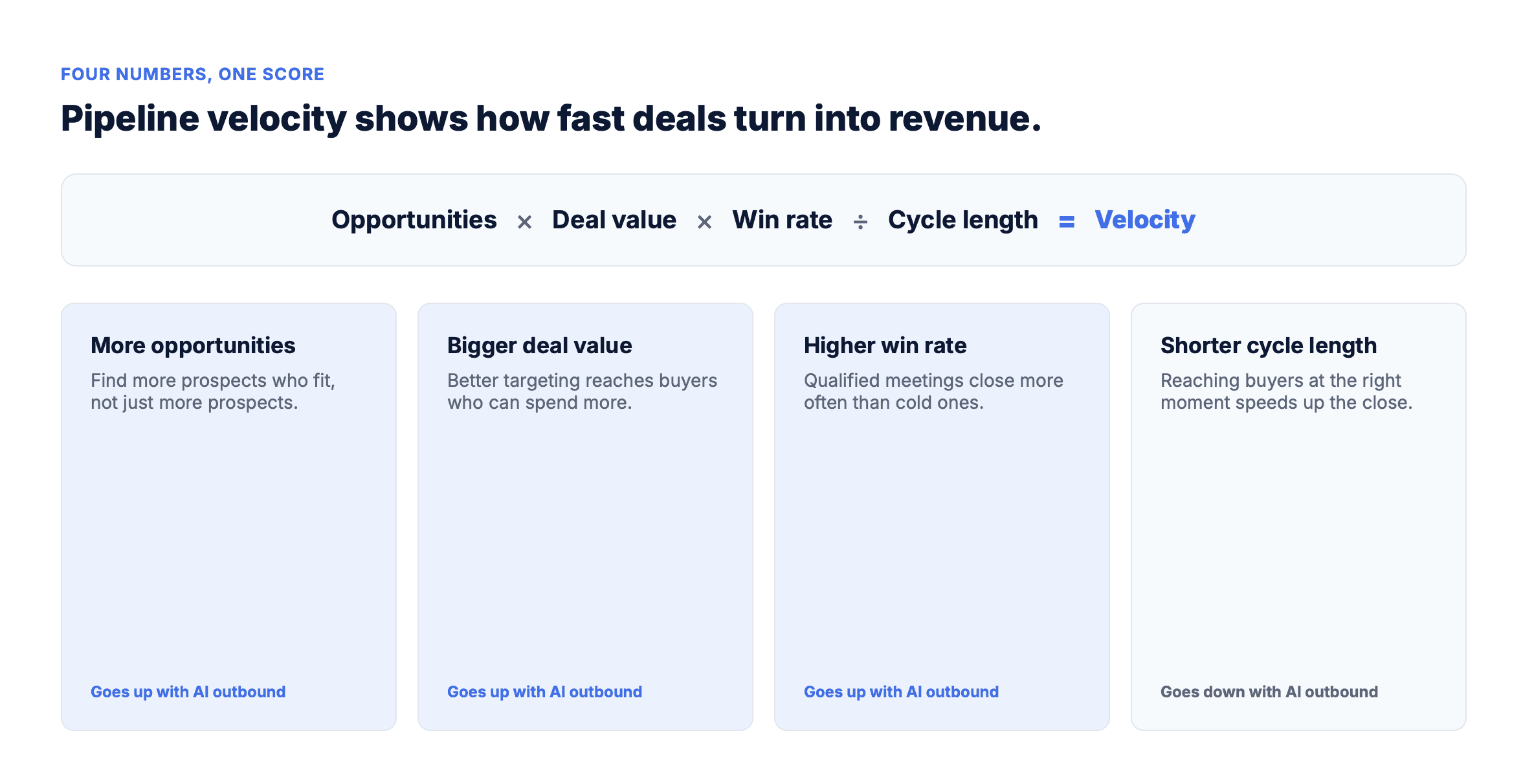
Sales pipeline velocity measures how fast revenue moves through your sales funnel. It is calculated by multiplying the number of qualified opportunities by your average deal value and win rate, then dividing by your average sales cycle length. For Nordic B2B teams, AI-driven outbound directly improves three of those four variables by delivering better-qualified opportunities faster and at higher conversion rates.
Why Pipeline Velocity Is the Metric Growth-Stage B2B Teams Should Obsess Over
Most B2B sales teams track pipeline volume. Fewer track pipeline velocity, which is the metric that actually predicts how much revenue will close this quarter. A large pipeline full of slow-moving, low-fit opportunities is not an asset. It is a liability that consumes sales capacity without producing results.
According to Salesforce's 2024 State of Sales report, high-performing sales teams are 2.8 times more likely to use pipeline velocity as a core metric than underperforming teams. The distinction matters because velocity exposes problems that volume metrics hide: a long average sales cycle, a low win rate on outbound-sourced deals, or a deal value that has drifted below target because qualification standards have slipped.
For growth-stage and enterprise B2B companies in the Nordics, where sales cycles tend to be longer and buying committees tend to be larger than in US markets, velocity optimization is not a nice-to-have. It is the difference between hitting the year's revenue target and explaining a Q4 miss.
What Is Sales Pipeline Velocity and How Is It Calculated?
Sales pipeline velocity is the rate at which qualified opportunities convert to closed revenue within a defined period. The formula is: (number of qualified opportunities x average deal value x win rate) divided by average sales cycle length in days. A higher number means more revenue is converting faster.
Each variable in the formula represents a lever. You can increase velocity by adding more qualified opportunities, increasing average deal value through better targeting, improving win rate through better discovery and fit, or shortening the sales cycle by engaging prospects who already have urgency. AI-driven outbound affects all four levers, but its most direct impact is on the first: the number of genuinely qualified opportunities entering the funnel.
The critical word is qualified. An opportunity only belongs in the velocity calculation if it meets your defined criteria for company fit, stakeholder authority, and buying urgency. Padding the pipeline with under-qualified leads inflates the opportunity count while dragging down win rate and extending average cycle length. The net effect on velocity is negative, even though the pipeline looks fuller.
How Does AI Outbound Improve Pipeline Velocity for Nordic B2B Teams?
AI-driven outbound improves pipeline velocity by replacing volume-based prospecting with signal-based targeting that identifies prospects at the moment they are most likely to buy. For Nordic B2B teams, this means outreach that reaches the right decision-maker at the right company during a window of genuine buying urgency, rather than interrupting contacts who have no active problem to solve.
Our AI Twin identifies that window by processing multiple data layers simultaneously: firmographic signals like company size and growth trajectory, technographic signals like tools a company is actively using or replacing, and behavioral signals like hiring patterns, leadership changes, and content engagement. A prospect who just hired a Head of Revenue Operations at a Series B SaaS company in Stockholm is in a fundamentally different buying posture than someone with the same job title at a stable mid-market firm.
That targeting precision is what separates AI-powered outbound from traditional list-based prospecting. According to McKinsey's 2024 B2B Pulse survey, companies using AI-assisted prospecting report a 35% reduction in average sales cycle length compared to those using manual research and static lists. For a Nordic team running six to nine month enterprise cycles, a 35% reduction is measured in months, not days, and the velocity impact is substantial.
The human side of the equation matters just as much. We manage every prospect conversation directly, with experienced team members handling replies, objections, and meeting booking. No automated bot represents a client in a live conversation. This distinction is what allows us to maintain the relationship quality that Nordic buyers expect while operating at a scale that no in-house SDR team could match. You can see how the full model works at
What Separates a Commodity Lead-Gen Agency from an AI-Driven Pipeline Partner?
A commodity lead-gen agency delivers contact lists, email sequences, and activity metrics: emails sent, open rates, reply rates. An AI-driven pipeline partner delivers qualified opportunities with documented fit criteria, measured against pipeline velocity rather than outreach volume.
The distinction shows up most clearly in what gets reported. A volume-based agency reports that 500 emails were sent and 40 replies received. An AI-driven partner reports that 12 qualified meetings were booked with decision-makers who met four specified criteria, and that three of those meetings have already progressed to proposal stage.
For growth-stage B2B companies evaluating outbound partners, the right questions to ask are not about volume. They are about qualification standards, how prospects are scored before outreach begins, how conversations are handled after the first reply, and what the average progression rate from booked meeting to qualified opportunity looks like across the partner's client base.
We book an average of 15 to 30 qualified meetings per month for clients across industries including SaaS, fintech, consulting, and manufacturing. That range reflects the difference between industries and average deal complexity, but the qualification standard behind every meeting is consistent. The meetings that reach a client's calendar have already passed a multi-dimensional fit check before the first message was sent.
This is why Nordic B2B teams specifically benefit from a partner like us rather than building an in-house SDR function or running manual outreach. The Nordics market rewards relationship quality and specificity. Generic outreach fails here faster than in most markets. AI-driven research combined with human-managed conversations is the model that works in this context.
Common Mistakes to Avoid
Measuring outbound success by activity volume. Emails sent and connections made are inputs, not outcomes. Teams that optimize for activity metrics tend to increase volume while decreasing quality, which lowers win rates and slows pipeline velocity. The only output metric that matters for velocity is the number of qualified opportunities that enter the pipeline and the rate at which they close.
Ignoring sales cycle length as a velocity lever. Most teams focus on adding more opportunities or increasing deal size. Reducing average sales cycle length has an equally powerful effect on velocity and is often the most addressable variable. AI-driven targeting that reaches prospects during active buying windows compresses the cycle from the first conversation.
Treating AI outbound as a replacement for sales judgment. AI identifies and prioritizes prospects with precision. It does not replace the human judgment required to navigate a complex B2B buying committee or adapt a conversation when a prospect reveals an unexpected concern. Teams that deploy AI without a skilled human layer in the conversation see gains in outreach efficiency but losses in conversion quality.
Applying US outbound playbooks directly to Nordic markets. Nordic buyers have different expectations around directness, relationship-building pace, and communication style. Outreach that performs well in a US market often reads as aggressive or impersonal to a Swedish or Finnish buyer. Pipeline velocity in the Nordics requires outreach calibrated to how decisions are actually made here.
Frequently Asked Questions
1. What is sales pipeline velocity and why does it matter for B2B teams?
Sales pipeline velocity measures how fast qualified opportunities convert to closed revenue. The formula is: qualified opportunities multiplied by average deal value and win rate, divided by average sales cycle length. It matters because it identifies which variable is limiting revenue growth, whether that is deal volume, win rate, deal size, or cycle length. Fixing the right variable accelerates revenue faster.
2. How does AI outbound specifically improve sales pipeline velocity?
AI outbound improves sales pipeline velocity primarily by increasing the quality and fit of opportunities entering the funnel, which raises win rates and shortens sales cycles. AI tools identify prospects during active buying windows using firmographic, technographic, and behavioral signals. Higher-fit prospects close faster and at higher rates, which improves all four variables in the velocity formula simultaneously.
3. What is a good sales pipeline velocity benchmark for Nordic B2B companies?
Pipeline velocity benchmarks vary significantly by industry, deal size, and sales cycle length, so absolute numbers are less useful than tracking directional improvement. For Nordic B2B companies running outbound programs, a consistent month-on-month increase in the ratio of closed revenue to active pipeline value is the most reliable indicator. Teams using AI-assisted prospecting typically report velocity improvements of 20 to 35% within the first two quarters.
4. How many qualified meetings per month should an AI outbound program deliver?
A well-structured AI outbound program that combines intelligent prospect research with human-managed conversations typically delivers 15 to 30 qualified meetings per month. The exact number depends on target market size, deal complexity, and qualification criteria. More important than the raw count is the progression rate from meeting to qualified opportunity, which is the direct input to sales pipeline velocity.
5. What makes outbound lead generation in the Nordics different from other markets?
Nordic B2B buyers place higher weight on relevance, specificity, and relationship quality than buyers in many other markets. Generic, volume-based outreach fails faster here because Nordic decision-makers receive enough inbound attention to be selective. Outbound programs that work in the Nordics use precise targeting, personalized messaging grounded in real research, and human-managed conversations rather than automated sequences.
Want to See What a Faster Pipeline Actually Looks Like?
If pipeline velocity is a priority for your Nordic sales team this year, book a call with us to walk through how the AI Twin qualification process works and what a pipeline of 15 to 30 genuinely qualified meetings per month means for your revenue targets.
Added 09.07.2026