Quick answer: A LinkedIn growth engine combines outreach and personal branding into one compounding cycle. Outreach builds relevant connections, content builds familiarity with those same connections, and over time the network itself becomes more valuable, turning cold outbound into warmer, faster conversations.
Most companies run outreach and content as two disconnected activities. One team sends connection requests and messages. Someone else occasionally posts on LinkedIn, unrelated to who’s actually being targeted. But every prospect experiences both through the same profile, so treating them separately wastes the compounding effect.
According to LinkedIn’s 2025 B2B Trends report, sales professionals who post content consistently generate 45% more opportunities than those who don’t engage on the platform at all. That statistic only tells half the story though. The real advantage shows up when outreach and content target the same audience deliberately, not by coincidence.
What Is the LinkedIn Growth Engine?
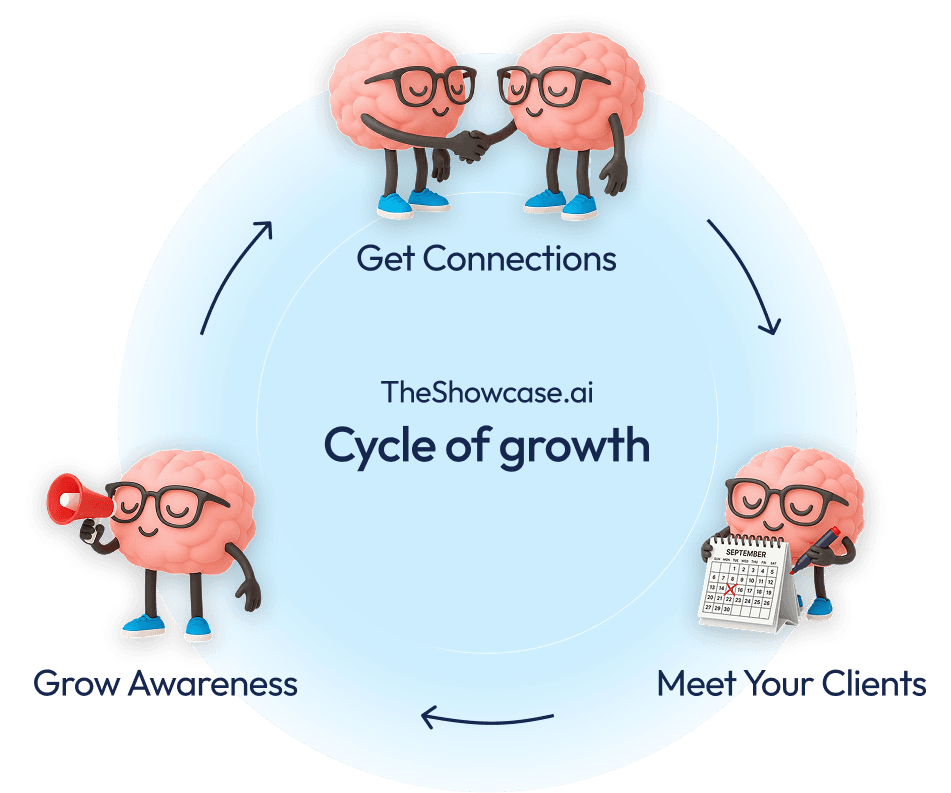
The LinkedIn growth engine is a repeating cycle of three stages: get connections, meet your clients, and grow awareness, where each stage strengthens the next instead of existing as an isolated activity. Connections come from targeted outreach, meetings come from qualified conversations, and awareness comes from consistent content that keeps you visible to the network you’ve built.
Most companies run one campaign, get some meetings, and stop, then start a completely separate campaign later with no memory of what came before. The growth engine works differently. Every new connection adds to a growing audience that sees your content. Every piece of content builds familiarity with people who were once cold outbound targets.
Over months, this means new outreach increasingly lands with people who already recognize your name, because they’ve seen your posts even if they never replied to a message. That’s a structurally different position than starting cold every single time.
How Do You Get the Right Connections First?
Getting the right connections means using targeted matchmaking to identify and connect with people who are genuinely relevant to your business, not accumulating LinkedIn connections for volume’s sake. This is the entry point of the entire growth engine, and getting it wrong undermines everything downstream.
The process starts with a defined ideal customer profile, then maps the market to identify the right companies and the right people inside them. From there, prospects get qualified using real context, not just job title and company size, before any outreach begins.
The important mindset shift is treating connections as long-term network assets rather than campaign statistics that get reported once and forgotten. A relevant connection made today might not convert for six months, but it still sits in your network, seeing your content and forming an impression the entire time. Random, unqualified connections don’t do that, because there’s no reason for them to pay attention to anything you post later.
Why Does a ‘Not Now’ Still Matter?
A “not now” matters because most B2B buying cycles don’t align with your outreach timing, and a prospect who isn’t ready today can become a qualified opportunity months later if they stay familiar with your name. Treating every non-conversion as a dead end wastes the relationship you just built.
Some connections become conversations. Some conversations become meetings. Some meetings become customers. That’s the obvious commercial path, and it’s the one most sales teams optimize for exclusively. But B2B buying rarely moves that fast, and Gong’s 2024 analysis of sales cycles found that complex B2B deals now take an average of 102 days from first contact to close, often longer.
That gap is exactly where content earns its place. A prospect who said “not now” three months ago, but has seen five relevant posts since, is in a completely different position than one who heard nothing after the initial message. The relationship didn’t end, it just moved into a different stage of the same cycle.
How Does Content Turn Cold Prospects Into Warm Ones?
Content turns cold prospects into warm ones by giving you a way to stay visible to your network without sending more messages, so that by the time you do reach out again, you’re a familiar name instead of a stranger. This is the function personal branding plays inside the growth engine.
Consistent posting can show a connected audience what you know, how you think, and what problems you understand, without asking anything of them. Over time, this builds a form of recognition that changes how the next message lands.
Connection requests get accepted more readily from a recognizable profile
Replies come with more context because the person already has an impression of you
Conversations start with some baseline trust instead of none
Inbound interest starts appearing from people never directly messaged
The contrast is simple to describe. A cold message gets read with the question “who is this?” A message from someone whose posts you’ve seen gets read with “I’ve seen this person’s content before.” Those are fundamentally different starting points for the same conversation.
The Network Compounding Framework
The Network Compounding Framework describes how a LinkedIn network increases in value over time when outreach and content are run together consistently, rather than staying flat the way a static contact list does. This is the mechanism behind why the growth engine gets stronger with each cycle.
Build the initial network Do this: run targeted outreach to connect with qualified, relevant prospects. Why it matters: this creates the audience everything else depends on.
Publish consistent content Do this: share posts that reflect real expertise and customer-relevant insight on a regular schedule. Why it matters: irregular posting fails to build the recognition that makes the next stage work.
Let familiarity accumulate Do this: allow weeks or months to pass while the network sees and absorbs your content. Why it matters: familiarity is a slow-building asset, not an instant one.
Re-engage with fresh outreach Do this: reach back out to previously cold or dormant contacts once enough content has been seen. Why it matters: these messages now land with people who already recognize your name.
Expand and repeat Do this: add new qualified connections into the same content cycle continuously. Why it matters: the network keeps growing in both size and average familiarity, compounding results over time.
HubSpot’s 2024 State of Marketing report found that companies publishing content consistently over 12 months saw 3.5 times more organic engagement than those posting sporadically, which supports the idea that irregular content simply doesn’t build the recognition this framework depends on.
Common Mistakes to Avoid
Running outreach and content as separate workstreams. When different teams handle each with no shared targeting, the compounding effect disappears entirely. The prospect experiences one profile, and it should feel coordinated.
Posting content with no connection to who you’re actually targeting. Generic industry commentary might get likes, but it doesn’t build recognition with the specific accounts in your pipeline. Content needs to speak to the same audience outreach is targeting.
Giving up on connections after one “not now.” Removing a contact or ignoring them after a stalled conversation throws away a relationship that content could have kept warm. That connection is still worth something months later.
Measuring content by likes instead of pipeline influence. Vanity metrics feel good but don’t tell you whether the right people are seeing your posts. Track whether previously cold contacts are re-engaging over time instead.
Where TheShowcase.ai Fits
This is the exact reason we built LinkedIn outreach and Personal Branding as parts of the same system rather than separate products. Our AI Twin identifies and connects with the right prospects, and once they’re in your network, ongoing content keeps you visible to them. Humans still manage every conversation and every piece of content strategy, the AI just makes sure both are aimed at the same relevant audience.
Frequently Asked Questions
1. Does LinkedIn personal branding actually help outbound sales?
Yes. Personal branding keeps you visible to prospects who’ve already been connected through outreach, so when you re-engage them later, you’re recognized rather than cold. Familiarity built through content directly improves how outbound messages land.
2. How is the LinkedIn growth engine different from just posting content?
The growth engine combines targeted outreach with consistent content, so the people seeing your posts are actually relevant prospects, not a random audience. Posting alone without qualified connections behind it has far less commercial impact.
3. How long does it take to see results from a LinkedIn growth engine strategy?
Because B2B buying cycles average over 100 days according to Gong’s 2024 research, expect the compounding effect to build over three to six months, not weeks. Early cycles focus on building the network, later cycles benefit from accumulated familiarity.
4. Should outbound and inbound LinkedIn efforts be managed separately?
No. They should target the same relevant audience so outreach and content reinforce each other. Treating them as unrelated strategies wastes the recognition content builds and the connections outreach creates.
5. What’s the biggest mistake companies make with LinkedIn growth strategy?
The most common mistake is running outreach campaigns and content publishing as disconnected activities with no shared targeting. This prevents the compounding effect that makes a real growth engine work, leaving both efforts weaker than they could be together.
If you want a LinkedIn network that gets more valuable every time you use it, talk to our team about how LinkedIn outreach and Personal Branding work together inside one system.
Added 20.08.2026