Headcount-heavy outbound agencies fail to scale in the Nordics because adding more SDRs adds more cost, inconsistency, and ramp time, not more results. AI-powered outbound solves this by running personalized, high-volume prospecting continuously, while a human team handles every conversation. The result is scalable B2B outbound in the Nordics that improves as it runs, without a proportional increase in headcount or budget.
Why the Nordic B2B Market Demands a Different Outbound Model
The Nordics are not a volume market. Decision-makers here have a low tolerance for generic outreach, long sales cycles reward relationship-building over pressure tactics, and the buyer pool in any given vertical is smaller than in Central Europe or the US. That combination punishes spray-and-pray outbound hard.
According to LinkedIn's 2024 State of Sales report, 89% of buyers say they are more likely to consider a vendor who understood their specific business situation. In a market the size of Sweden or Finland, burning through prospects with irrelevant messaging does not just lose a deal. It damages a brand's reputation in a community where buyers know each other.
Traditional outbound agencies responded to this problem by hiring more senior SDRs, adding local language specialists, and creating smaller, more targeted lists. The logic is sound. The economics are not. Each new hire brings onboarding time, turnover risk, and a salary that does not flex with output.
Why Does Headcount-Heavy Outbound Break at Scale?
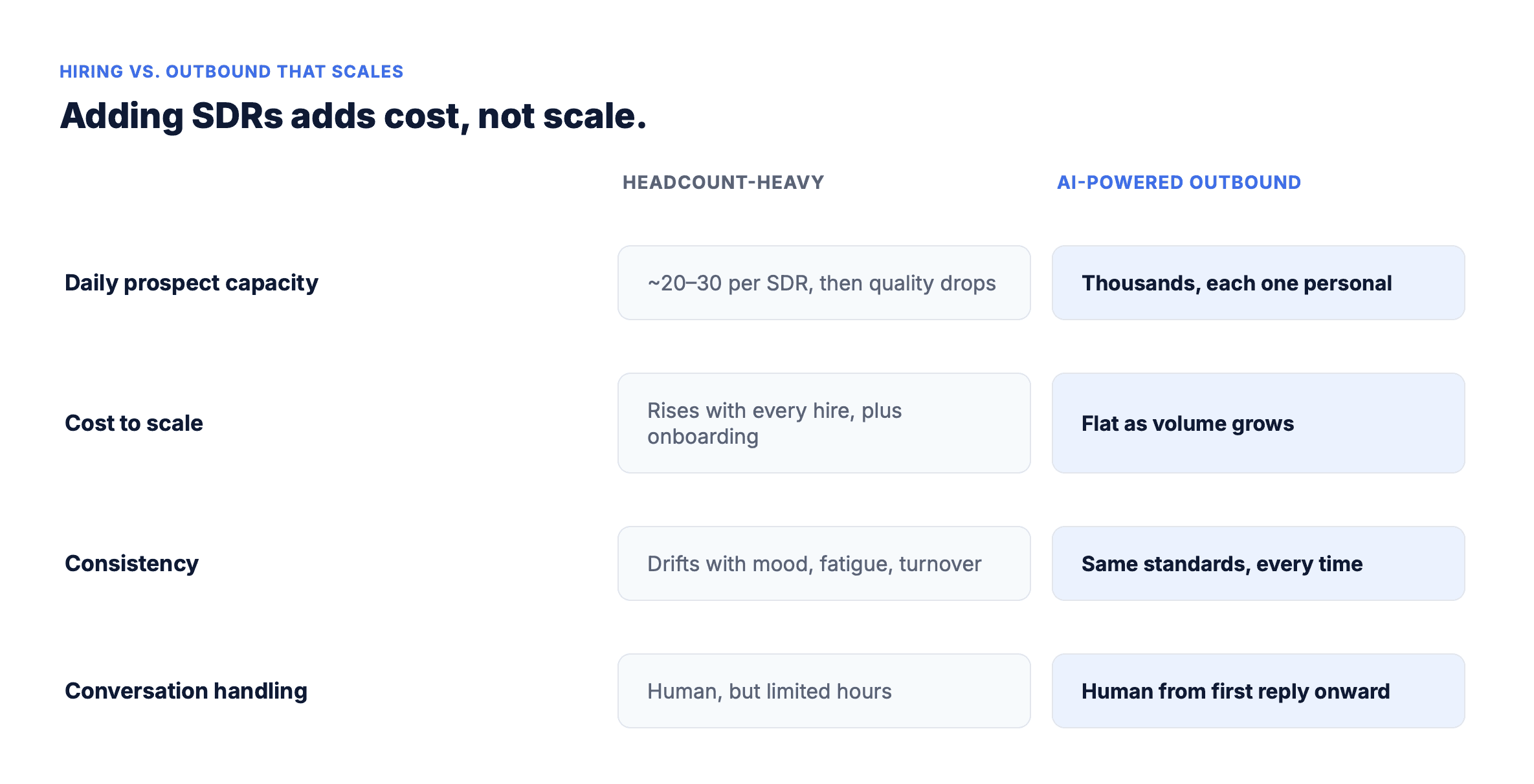
Headcount-heavy outbound breaks at scale because human SDRs have a fixed daily capacity, and quality degrades as that capacity is pushed. A single SDR can research and personalize outreach for roughly 20 to 30 prospects per day before message quality drops. Multiply that across a team, add sick days, attrition, and inconsistent coaching, and the output ceiling becomes visible fast.
We have run campaigns across more than 200 B2B clients, and the pattern is consistent. Companies that scale outbound by adding SDRs see diminishing returns after the third or fourth hire. The marginal meeting booked per additional salary rises sharply, and the quality of those meetings tends to fall because junior SDRs chase activity metrics rather than fit.
The structural problem is that personalization and volume sit at opposite ends of a human bandwidth equation. You can have one at scale, but not both, unless you remove the bandwidth constraint entirely.
How Does AI Outbound Change the Economics of Prospecting?
AI outbound changes the economics of prospecting by removing the trade-off between personalization and volume. An AI system can research, segment, and personalize outreach across thousands of prospects simultaneously, operating on criteria that a human SDR would spend hours applying manually.
Our AI Twin does exactly this. It identifies prospects who match a client's ideal customer profile, draws on company-level and individual-level signals to personalize each message, and runs outreach continuously without fatigue or quota pressure. The human team then takes over the moment a prospect responds, managing every conversation through to a booked meeting.
According to McKinsey's 2024 B2B Pulse survey, companies using AI in their sales processes reported a 15 to 20 percent increase in sales productivity compared to teams relying on manual processes alone. In the Nordics, where the addressable market in any niche is finite, that efficiency gain is not a nice-to-have. It is a competitive requirement.
Learn more about how our AI Twin works at
What Makes AI Outbound More Consistent Than a Human SDR Team?
AI outbound is more consistent than a human SDR team because it applies the same targeting logic, messaging framework, and follow-up sequence to every prospect, every time, without variation caused by mood, experience level, or competing priorities.
Consistency is underrated in outbound. When a human SDR has a slow week, they often default to softer targets or looser qualification criteria to hit activity numbers. That creates a pipeline full of meetings that will not close. When an AI system has a slow week, the criteria do not change. The output adjusts, but the standard does not.
For Nordic B2B companies targeting a defined segment, such as CFOs at mid-market SaaS companies in Sweden or procurement leads at manufacturing firms in Norway, that consistency means the meetings that get booked are genuinely qualified. Clients using our model typically book 15 to 30 qualified meetings per month, not because we send more messages, but because the targeting does not drift.
Common Mistakes to Avoid
Treating AI outbound as a volume play. The point of AI in outbound is not to send more emails. It is to send better-targeted messages at a scale a human team cannot sustain. Companies that use AI purely to increase send volume without improving targeting criteria see high activity numbers and flat meeting rates.
Removing humans from prospect conversations entirely. AI handles prospecting and initial engagement at scale, but no prospect in a Nordic B2B context wants to discover mid-conversation that they have been talking to a bot. Every conversation at our agency is managed by a human from the first reply onward. That distinction protects both the relationship and the brand.
Scaling outbound before the ICP is validated. AI amplifies whatever targeting logic you give it. If the ideal customer profile is vague or based on assumptions rather than closed-won data, AI will find and engage thousands of the wrong prospects very efficiently. Garbage in, garbage out, just faster.
Measuring success by meetings booked rather than pipeline generated. A high meeting count is meaningless if the prospects do not convert past the first call. Qualified meetings, meaning prospects who match the ICP, have the budget, and have expressed a genuine need, are the only metric that connects outbound activity to revenue.
Why TheShowcase.ai Solves This Differently
Most outbound agencies in the Nordics either offer a fully human SDR service, which is expensive and hard to scale, or a software tool that automates sending and leaves the strategy and conversations to the client. We operate in neither category.
Our AI Twin handles prospecting and personalization at a scale no SDR team can match. Our human team manages every conversation, qualifies every lead, and books every meeting. Clients get the output of a full outbound function without the headcount, the onboarding cycles, or the overhead. For companies selling into Sweden, Norway, Denmark, or Finland, where market size makes targeting precision non-negotiable, that combination produces results that neither a traditional agency nor a software tool can replicate alone.
Frequently Asked Questions
1. What is scalable B2B outbound in the Nordics?
Scalable B2B outbound in the Nordics means running a consistent, high-quality prospecting operation across Swedish, Norwegian, Danish, and Finnish markets without proportionally increasing headcount. AI-powered outbound achieves this by automating prospect research and personalization, while human teams manage every conversation to protect relationship quality.
2. Why do traditional outbound agencies struggle to scale in Scandinavia?
Traditional outbound agencies struggle to scale in Scandinavia because the market is relationship-driven and the buyer pools in most verticals are small. Adding more SDRs increases cost and inconsistency without improving targeting quality. Nordic buyers have a low tolerance for generic outreach, so volume-first approaches damage brand reputation faster than they generate pipeline.
3. How many meetings can AI-powered outbound generate per month in the Nordics?
Companies using an AI-powered outbound model in the Nordics typically book 15 to 30 qualified meetings per month, depending on the target market size and ICP specificity. This figure reflects meetings with decision-makers who match the client's ideal customer profile, not raw calendar bookings that include poor-fit prospects.
4. What is the difference between an AI outreach agency and outreach software?
An AI outreach agency provides both the AI system and the human team to run campaigns end to end. Outreach software provides the tool and leaves strategy, targeting, copywriting, and conversation management to the client. An agency model removes the execution burden entirely and is accountable for meeting outcomes, not just platform access.
5. Is AI outbound suitable for niche B2B markets in Sweden?
AI outbound is especially effective in niche B2B markets like Sweden because it applies precise targeting criteria at scale without the quality drift that affects human SDR teams over time. The smaller the addressable market, the more important it is that every outreach message is relevant, and AI maintains that standard consistently across the entire prospect list.
Ready to Build a Pipeline That Scales Without Adding Headcount?
If your current outbound approach depends on how many people you can hire and keep, the ceiling is already visible. Book a free call with our team and see how the AI Twin model fills your sales calendar with qualified Nordic decision-maker meetings, without the overhead of a traditional SDR function.
Added 15.07.2026