A LinkedIn connection message that gets accepted by a Swedish C-suite buyer is short, specific, and contains zero sales language. Swedish executives, particularly CEOs and CFOs in mid-market companies, accept connection requests based on perceived relevance and professional credibility, not charm. The message needs to give a clear, honest reason for connecting in fewer than 60 words.
Why Swedish Executives Respond Differently to LinkedIn Outreach
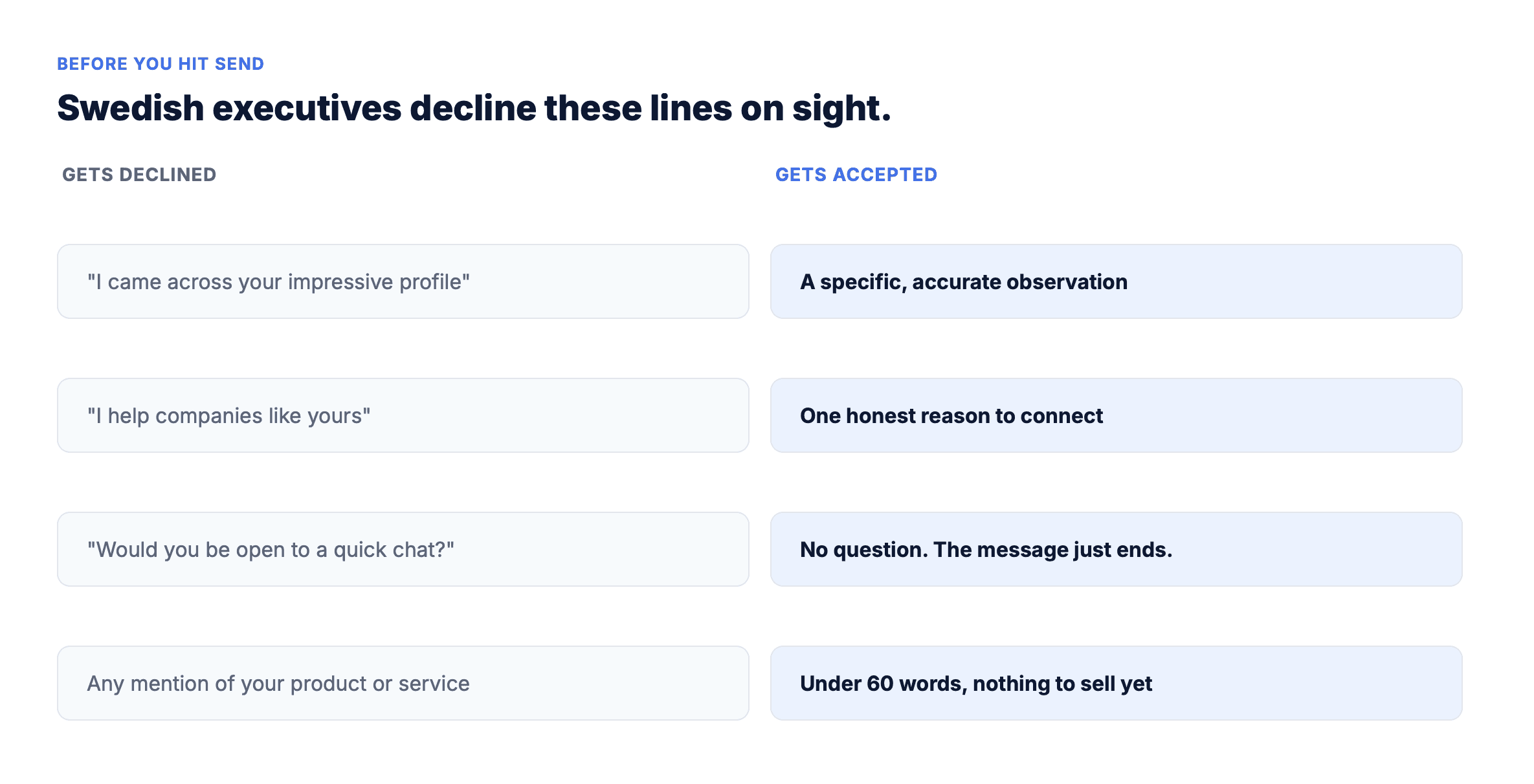
Swedish business culture places a premium on directness and authenticity. Flattery is read as manipulation. Vague curiosity messages are deleted without a second look. This is not unique to Sweden, but the threshold for rejection is noticeably lower in the Nordic market than in, for example, the US or UK. A Swedish CFO who receives a message starting with "I came across your impressive profile" will not accept the request.
The volume of LinkedIn outreach hitting executive inboxes in Sweden has increased sharply. According to LinkedIn's 2024 State of Sales report, InMail and connection request volume grew 22% year over year globally, with Northern Europe seeing above-average growth as more companies use the platform for outbound prospecting. The result is that Swedish decision-makers are more selective than they were two years ago, and the bar for what counts as a relevant message has risen with it.
What Makes a LinkedIn Connection Message Work for Swedish Buyers?
A LinkedIn connection message works for Swedish C-suite buyers when it demonstrates that you have done specific research on the recipient, states a clear and honest reason for connecting, and asks for nothing. That last point is critical. The connection request is not the pitch. It is the handshake. Swedish business culture values that distinction, and messages that conflate the two are declined almost universally.
Three structural elements separate accepted messages from ignored ones. First, a specific observation about the person's company, role, or recent activity. Not a compliment, an observation. Second, a one-sentence reason why connecting makes sense for both parties. Third, no question, no ask, no CTA. The message ends after the reason. This structure works because it respects the executive's time and signals that you understand the norms of professional communication in the Nordic context.
How Long Should a LinkedIn Connection Request Be?
A LinkedIn connection request to a Swedish C-suite buyer should be between 40 and 60 words. That is the optimal range based on what we observe across our outreach campaigns at TheShowcase.ai. Messages shorter than 40 words lack enough context to feel credible. Messages longer than 60 words signal that a pitch is coming and trigger the instinct to decline.
Character limit on LinkedIn connection requests is 300 characters for mobile-initiated requests and up to 300 characters on desktop as well, though this varies. Staying well under that limit is a signal of confidence, not laziness. Swedish executives interpret brevity as respect. A message that fits in three short sentences and says exactly what it needs to say will outperform a polished paragraph every time.
What Phrases Immediately Kill Acceptance Rates?
Certain phrases immediately kill acceptance rates with Swedish C-suite buyers. Removing them from your templates is the fastest improvement most teams can make.
"I came across your impressive profile" signals a template. Delete it.
"I'd love to pick your brain" is casual and implies you want something for free.
"I help companies like yours" is the opening of a pitch, not a connection message.
"I noticed we have mutual connections" is filler. Everyone has mutual connections.
Any reference to your product, service, or company offering in the first message.
Questions that require a reply to make sense of the connection, such as "Would you be open to a quick chat?"
According to Gong's 2024 outbound research, messages containing explicit sales language in the opening line have a 47% lower response rate than messages that lead with a contextual observation. That pattern holds across channels and is especially pronounced in relationship-driven markets like Sweden.
This is one of the core principles behind how our human team at TheShowcase.ai manages LinkedIn conversations on behalf of clients. Our AI Twin identifies the right prospects and surfaces the relevant context. Our human team writes and sends messages that sound like a real professional reaching out, because they are. You can see the full model at
Why Does Personalization Actually Matter Here?
Personalization matters in LinkedIn outreach to Swedish executives because the alternative is obvious and instantly disqualifying. A message that could have been sent to 500 people reads like a message that was sent to 500 people. Swedish C-suite buyers make fast, accurate judgments about whether a message is genuine or automated, and they act on that judgment immediately.
Real personalization does not require deep research on every prospect. It requires one specific, accurate detail that could only appear in a message written for that person. A reference to a recent company announcement, a product line the company just launched, a market the person recently commented on publicly, or a specific challenge common to their industry segment at this moment. One accurate detail is enough to signal genuine intent. Everything else in the message can be structured.
This is where AI-assisted outreach at scale becomes genuinely useful. Our AI Twin at TheShowcase.ai processes public signals about each prospect, including recent LinkedIn activity, company news, and industry context, to surface that one relevant detail for every contact. The human team then builds the message around it. Clients typically see 15 to 30 qualified meetings booked per month using this approach, not because we send more messages, but because the right detail lands with the right person at the right time.
Common Mistakes to Avoid
Sending a connection request and a pitch in the same message. This is the single most common mistake in LinkedIn outreach to Swedish executives. The connection request earns the right to a conversation. It does not start one. Combining them collapses a multi-step trust process into a single moment and almost always results in a decline.
Using the same message template for all seniority levels. A message that works for a Sales Director will not work for a CEO. C-suite buyers evaluate relevance through a different lens. They want to understand quickly whether you understand their level of responsibility and the decisions they actually own. Adjust the frame of your message accordingly.
Following up on a declined or unanswered request with an InMail. This signals that you are running a volume play and do not read social cues. In the Swedish market, this kind of persistence reads as poor judgment rather than determination. Move on and refine your targeting instead.
Ignoring the profile photo and headline when assessing fit. Swedish C-suite buyers with incomplete or clearly outdated LinkedIn profiles are often less active on the platform. Sending a carefully crafted message to someone who logs in twice a year is a waste of effort. Prioritize prospects who show recent activity signals.
Frequently Asked Questions
1. How long should a LinkedIn connection message be for Swedish C-suite buyers?
A LinkedIn connection message for Swedish C-suite buyers should be 40 to 60 words. This range provides enough context to be credible without signaling that a pitch follows. Brevity is interpreted as professionalism in Swedish business culture. Messages over 80 words are frequently declined without being read fully.
2. Should you include a question in a LinkedIn connection request to a Swedish executive?
No. A question in a LinkedIn connection request to a Swedish executive frames the message as the start of a sales process rather than a professional introduction. Swedish C-suite buyers are more likely to accept a request that states a clear reason for connecting and asks for nothing. Save the question for the follow-up message after acceptance.
3. What is the best time to send a LinkedIn connection request to a Swedish C-suite buyer?
Tuesday through Thursday, between 07:30 and 09:00 or 16:00 and 18:00 Swedish time, are the highest-engagement windows for LinkedIn connection requests targeting Nordic executives. Monday mornings and Friday afternoons see significantly lower acceptance rates. Sending at the start of the working day increases the chance your request appears at the top of the notification feed.
4. How many LinkedIn connection requests can you send per week without triggering restrictions?
LinkedIn restricts connection requests to approximately 100 per week for standard accounts. Accounts flagged for high decline rates face additional restrictions. For LinkedIn connection message Swedish C-suite outreach, quality targeting matters more than volume. Sending 20 highly relevant requests outperforms 100 generic ones in both acceptance rate and downstream conversation quality.
5. Is it better to send a LinkedIn connection request or an InMail to Swedish executives?
A connection request with a personalized note outperforms InMail for Swedish C-suite outreach in most cases. InMail carries a transactional connotation and often lands in a separate inbox that executives check infrequently. A well-crafted connection request appears as a direct notification and, when accepted, opens a conversation channel that feels more natural for relationship development.
Book Qualified Meetings With Swedish Decision-Makers
If your team is writing connection messages but not booking conversations, the messaging strategy is almost certainly the constraint, not the platform. Talk to our team and we will show you exactly how we approach LinkedIn outreach for Swedish and Nordic B2B markets, and what a qualified meeting pipeline looks like when the right message reaches the right person.
Added 02.07.2026