3 minute read
The Best Businesses Aren't Complicated:
They Do One Thing Really Well
The Best Businesses Aren't Complicated:
They Do One Thing Really Well
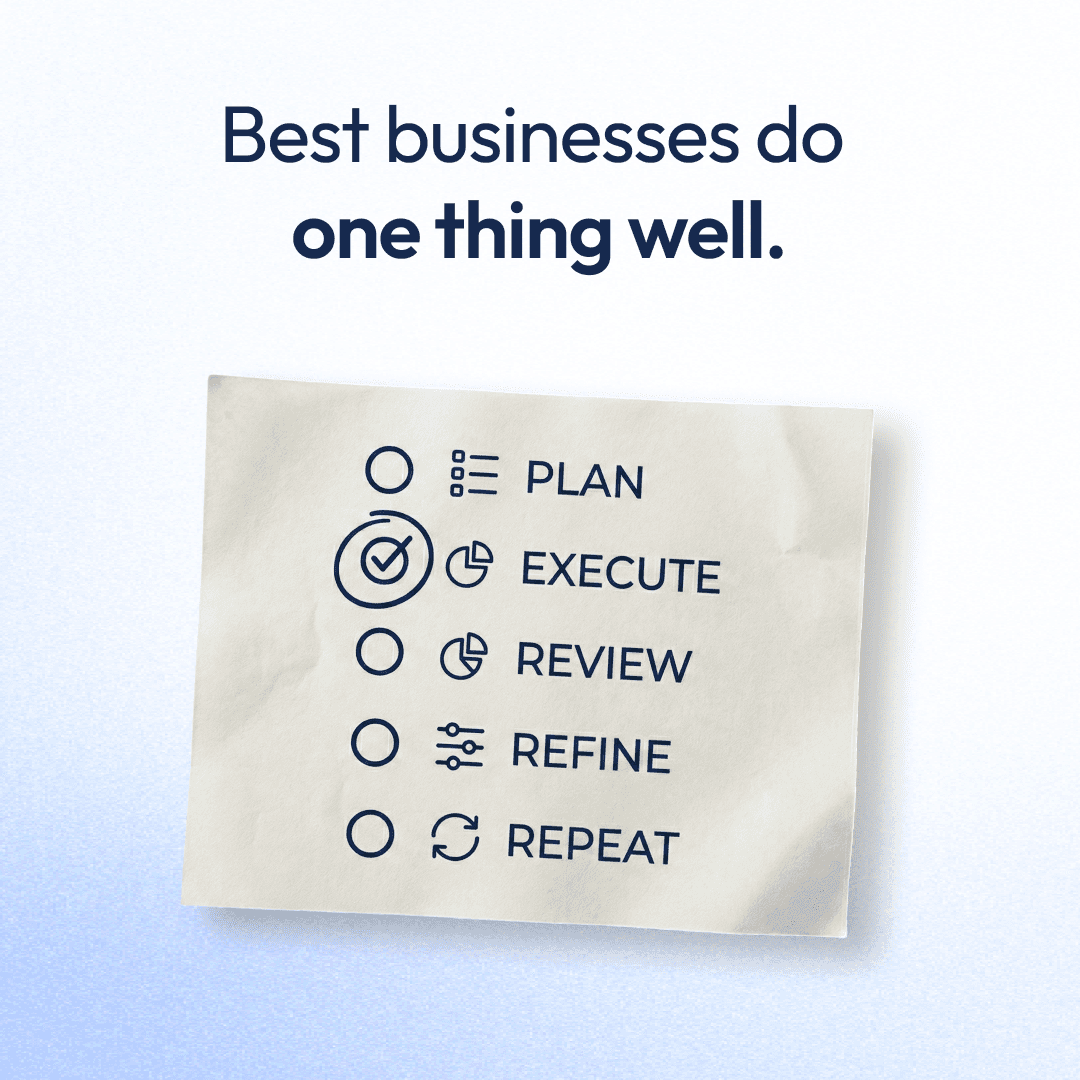

The best B2B businesses do one thing exceptionally well. They identify a specific problem, build everything around solving it better than anyone else, and resist every temptation to expand before they have truly mastered that one area. Complexity feels like ambition. In practice, it is the most common reason good B2B companies plateau instead of scale.
Why Most B2B Companies Dilute Their Own Strength
Most founders add complexity with good intentions. A client asks for one extra service. A competitor launches a new offering. A slow quarter makes a broader appeal seem safer. According to a 2025 Gartner report on B2B go-to-market strategy, companies with more than three core service offerings report 34% lower win rates in competitive deals compared to specialists with a single defined focus. The math is simple: buyers choose specialists when the decision matters.
This pattern shows up constantly across the B2B landscape. A consulting firm starts as a strategy house, then adds recruitment, then adds training, then adds software. At each step the founders believed they were growing. What they were actually doing was making themselves harder to refer, harder to position, and harder to close.
We went through exactly this at TheShowcase.ai. Early on, clients asked whether we could handle email marketing, social media management, full-funnel sales support. Every request felt like a growth signal. It was actually noise pulling us away from what we were genuinely building expertise in: using AI-powered outreach combined with human relationship management to book qualified meetings for B2B companies.
What Happens When You Try to Do Everything
When a B2B company spreads across ten offerings, it becomes average at all of them. No single area gets the depth of focus needed to develop a real competitive edge. The team's attention splits. The marketing message blurs. The operations grow complex in ways that are hard to reverse.
The consequences are predictable:
Prospects cannot quickly understand what problem you solve
Referrals dry up because nobody can explain you in one sentence
Your team trains across too many workflows and masters none
Pricing pressure increases because you look interchangeable with generalists
Sales cycles lengthen because buyers need longer to evaluate a broad offering
Simplicity is not a limitation. It is a strategic position. When you do one thing, all your learning compounds in that single area. Every client engagement makes you sharper at the same problem. Every process improvement applies everywhere. You get better faster than a generalist ever can.
According to LinkedIn's 2025 B2B Buyer Insights report, 71% of B2B buyers say specialist expertise is the top factor in choosing a new vendor, above price and above relationship history. Buyers are not looking for a vendor who can do everything. They are looking for the best at the thing they need right now.
How Specialization Compounds Over Time
Specialization creates compounding advantages that generalism cannot replicate. Every hour invested in a single discipline builds on the last. Processes become more efficient. Messaging becomes sharper. Talent hired for one specific function becomes genuinely world-class at it rather than merely competent across several.
This is what we built at TheShowcase.ai. The entire operation, from the AI Twin that identifies and personalizes outreach at scale to the human team that manages every prospect conversation, exists to solve one problem: booking qualified sales meetings for B2B companies. Not leads. Not awareness. Not brand content. Meetings with decision-makers who have a real reason to buy.
That focus produced real results. Clients across SaaS, fintech, consulting, and manufacturing average 15 to 30 qualified meetings per month through our outreach. That number is possible because every part of the operation is optimized for exactly that outcome, with nothing diluting the focus. You can learn more about how we built the process at
Specialization also makes scaling straightforward. One workflow can be documented, refined, and replicated. Ten workflows create ten times the complexity and ten times the room for inconsistency.
Why Simple Is Harder to Build but Easier to Sell
Choosing to do one thing well requires more discipline than adding features. Saying no to adjacent opportunities is harder than saying yes. Watching a competitor launch a new service and choosing not to follow takes genuine conviction.
But the commercial payoff is immediate and compounding. When a prospect asks what you do, you answer in one sentence. They know instantly whether you are relevant. There is no lengthy explanation, no qualifying questions, no confusion about which service to start with. The sales cycle shortens because the decision simplifies.
This is where TheShowcase.ai earns its position differently from a traditional outbound agency or an in-house SDR team. We do not offer a broad suite of marketing services. We book qualified meetings using AI-powered personalization and human-managed outreach, specifically for B2B companies that need a reliable pipeline without the overhead of building a sales development function from scratch. That clarity is itself a product. Clients know what they are buying before the first conversation ends.
Simplicity also scales better than complexity in marketing. A single clear message, repeated consistently across every channel, builds recognition faster than ten messages competing for the same audience's attention.
Common Mistakes to Avoid
Adding services to fill slow periods. When pipeline slows, the temptation is to broaden the offering to capture more types of buyers. This almost always makes the problem worse. A slow period signals a positioning or outreach problem, not a portfolio problem. Broadening the offer delays the diagnosis.
Confusing client requests with product strategy. Clients will ask for things that are adjacent to your core service. That is natural. It does not mean you should build them. Every yes to a non-core request is a no to getting better at what you are actually building. Filter requests through the question: does this make us better at the one thing we do, or does it add a second thing?
Believing complexity signals credibility. Some founders think a broader offering makes them look more established or capable. In practice, B2B buyers read complexity as a lack of specialization. A single sharp offering communicates confidence and mastery. A twelve-item service menu communicates that you are still figuring out your position.
Waiting until you are large to simplify. Simplification is harder to execute at scale than at an early stage. The longer you operate with a bloated offering, the more internal processes, client relationships, and team habits depend on that complexity. The best time to cut is before complexity becomes structural.
Frequently Asked Questions
1. Why does B2B sales focus matter more than broad offerings?
B2B sales focus drives compounding expertise. When a company directs all resources toward one specific problem, processes improve faster, messaging sharpens, and buyers recognize genuine specialization. According to LinkedIn's 2025 B2B Buyer Insights report, 71% of B2B buyers rank specialist expertise as their top vendor selection criterion.
2. How do you know which one thing to focus on in B2B?
Ask: what do we do better than any competitor, and what do clients specifically seek us out for? The answer to both questions should be the same. If your best clients all hired you for one specific outcome, that outcome is your core. Everything else is dilution.
3. Is it risky to turn down adjacent B2B opportunities?
Short-term, yes. You will decline revenue that seems easy to take. Long-term, the risk runs the other way. Companies that chase every adjacent opportunity rarely dominate any single category. Specialists consistently outperform generalists in B2B win rates and in the ability to command premium pricing.
4. How does TheShowcase.ai apply this principle to B2B lead generation?
TheShowcase.ai focuses exclusively on booking qualified meetings for B2B companies using AI-powered outreach and human-managed conversations. We do not offer full-funnel marketing, social media management, or general sales consulting. That singular focus is why clients average 15 to 30 qualified meetings per month through our process.
5. When should a B2B company consider expanding beyond its core focus?
Expansion makes sense only after you have genuinely dominated your core category, built repeatable operational systems, and have a market signal that an adjacent offering serves the same buyer with the same urgency. Expanding before mastery is not growth. It is distraction with extra steps.
Ready to Build a Focused B2B Pipeline?
If your outbound sales effort is spread too thin and the meetings you are booking do not convert, the problem is usually focus, not volume. Book a call with our team to see how a single, well-executed outreach process built around the AI Twin can deliver a consistent pipeline of qualified decision-maker meetings every month.
The best B2B businesses do one thing exceptionally well. They identify a specific problem, build everything around solving it better than anyone else, and resist every temptation to expand before they have truly mastered that one area. Complexity feels like ambition. In practice, it is the most common reason good B2B companies plateau instead of scale.
Why Most B2B Companies Dilute Their Own Strength
Most founders add complexity with good intentions. A client asks for one extra service. A competitor launches a new offering. A slow quarter makes a broader appeal seem safer. According to a 2025 Gartner report on B2B go-to-market strategy, companies with more than three core service offerings report 34% lower win rates in competitive deals compared to specialists with a single defined focus. The math is simple: buyers choose specialists when the decision matters.
This pattern shows up constantly across the B2B landscape. A consulting firm starts as a strategy house, then adds recruitment, then adds training, then adds software. At each step the founders believed they were growing. What they were actually doing was making themselves harder to refer, harder to position, and harder to close.
We went through exactly this at TheShowcase.ai. Early on, clients asked whether we could handle email marketing, social media management, full-funnel sales support. Every request felt like a growth signal. It was actually noise pulling us away from what we were genuinely building expertise in: using AI-powered outreach combined with human relationship management to book qualified meetings for B2B companies.
What Happens When You Try to Do Everything
When a B2B company spreads across ten offerings, it becomes average at all of them. No single area gets the depth of focus needed to develop a real competitive edge. The team's attention splits. The marketing message blurs. The operations grow complex in ways that are hard to reverse.
The consequences are predictable:
Prospects cannot quickly understand what problem you solve
Referrals dry up because nobody can explain you in one sentence
Your team trains across too many workflows and masters none
Pricing pressure increases because you look interchangeable with generalists
Sales cycles lengthen because buyers need longer to evaluate a broad offering
Simplicity is not a limitation. It is a strategic position. When you do one thing, all your learning compounds in that single area. Every client engagement makes you sharper at the same problem. Every process improvement applies everywhere. You get better faster than a generalist ever can.
According to LinkedIn's 2025 B2B Buyer Insights report, 71% of B2B buyers say specialist expertise is the top factor in choosing a new vendor, above price and above relationship history. Buyers are not looking for a vendor who can do everything. They are looking for the best at the thing they need right now.
How Specialization Compounds Over Time
Specialization creates compounding advantages that generalism cannot replicate. Every hour invested in a single discipline builds on the last. Processes become more efficient. Messaging becomes sharper. Talent hired for one specific function becomes genuinely world-class at it rather than merely competent across several.
This is what we built at TheShowcase.ai. The entire operation, from the AI Twin that identifies and personalizes outreach at scale to the human team that manages every prospect conversation, exists to solve one problem: booking qualified sales meetings for B2B companies. Not leads. Not awareness. Not brand content. Meetings with decision-makers who have a real reason to buy.
That focus produced real results. Clients across SaaS, fintech, consulting, and manufacturing average 15 to 30 qualified meetings per month through our outreach. That number is possible because every part of the operation is optimized for exactly that outcome, with nothing diluting the focus. You can learn more about how we built the process at
Specialization also makes scaling straightforward. One workflow can be documented, refined, and replicated. Ten workflows create ten times the complexity and ten times the room for inconsistency.
Why Simple Is Harder to Build but Easier to Sell
Choosing to do one thing well requires more discipline than adding features. Saying no to adjacent opportunities is harder than saying yes. Watching a competitor launch a new service and choosing not to follow takes genuine conviction.
But the commercial payoff is immediate and compounding. When a prospect asks what you do, you answer in one sentence. They know instantly whether you are relevant. There is no lengthy explanation, no qualifying questions, no confusion about which service to start with. The sales cycle shortens because the decision simplifies.
This is where TheShowcase.ai earns its position differently from a traditional outbound agency or an in-house SDR team. We do not offer a broad suite of marketing services. We book qualified meetings using AI-powered personalization and human-managed outreach, specifically for B2B companies that need a reliable pipeline without the overhead of building a sales development function from scratch. That clarity is itself a product. Clients know what they are buying before the first conversation ends.
Simplicity also scales better than complexity in marketing. A single clear message, repeated consistently across every channel, builds recognition faster than ten messages competing for the same audience's attention.
Common Mistakes to Avoid
Adding services to fill slow periods. When pipeline slows, the temptation is to broaden the offering to capture more types of buyers. This almost always makes the problem worse. A slow period signals a positioning or outreach problem, not a portfolio problem. Broadening the offer delays the diagnosis.
Confusing client requests with product strategy. Clients will ask for things that are adjacent to your core service. That is natural. It does not mean you should build them. Every yes to a non-core request is a no to getting better at what you are actually building. Filter requests through the question: does this make us better at the one thing we do, or does it add a second thing?
Believing complexity signals credibility. Some founders think a broader offering makes them look more established or capable. In practice, B2B buyers read complexity as a lack of specialization. A single sharp offering communicates confidence and mastery. A twelve-item service menu communicates that you are still figuring out your position.
Waiting until you are large to simplify. Simplification is harder to execute at scale than at an early stage. The longer you operate with a bloated offering, the more internal processes, client relationships, and team habits depend on that complexity. The best time to cut is before complexity becomes structural.
Frequently Asked Questions
1. Why does B2B sales focus matter more than broad offerings?
B2B sales focus drives compounding expertise. When a company directs all resources toward one specific problem, processes improve faster, messaging sharpens, and buyers recognize genuine specialization. According to LinkedIn's 2025 B2B Buyer Insights report, 71% of B2B buyers rank specialist expertise as their top vendor selection criterion.
2. How do you know which one thing to focus on in B2B?
Ask: what do we do better than any competitor, and what do clients specifically seek us out for? The answer to both questions should be the same. If your best clients all hired you for one specific outcome, that outcome is your core. Everything else is dilution.
3. Is it risky to turn down adjacent B2B opportunities?
Short-term, yes. You will decline revenue that seems easy to take. Long-term, the risk runs the other way. Companies that chase every adjacent opportunity rarely dominate any single category. Specialists consistently outperform generalists in B2B win rates and in the ability to command premium pricing.
4. How does TheShowcase.ai apply this principle to B2B lead generation?
TheShowcase.ai focuses exclusively on booking qualified meetings for B2B companies using AI-powered outreach and human-managed conversations. We do not offer full-funnel marketing, social media management, or general sales consulting. That singular focus is why clients average 15 to 30 qualified meetings per month through our process.
5. When should a B2B company consider expanding beyond its core focus?
Expansion makes sense only after you have genuinely dominated your core category, built repeatable operational systems, and have a market signal that an adjacent offering serves the same buyer with the same urgency. Expanding before mastery is not growth. It is distraction with extra steps.
Ready to Build a Focused B2B Pipeline?
If your outbound sales effort is spread too thin and the meetings you are booking do not convert, the problem is usually focus, not volume. Book a call with our team to see how a single, well-executed outreach process built around the AI Twin can deliver a consistent pipeline of qualified decision-maker meetings every month.