3 minute read
3 minute read
AI Won't Replace You: A Person Using AI Will Replace You
AI Won't Replace You: A Person Using AI Will Replace You
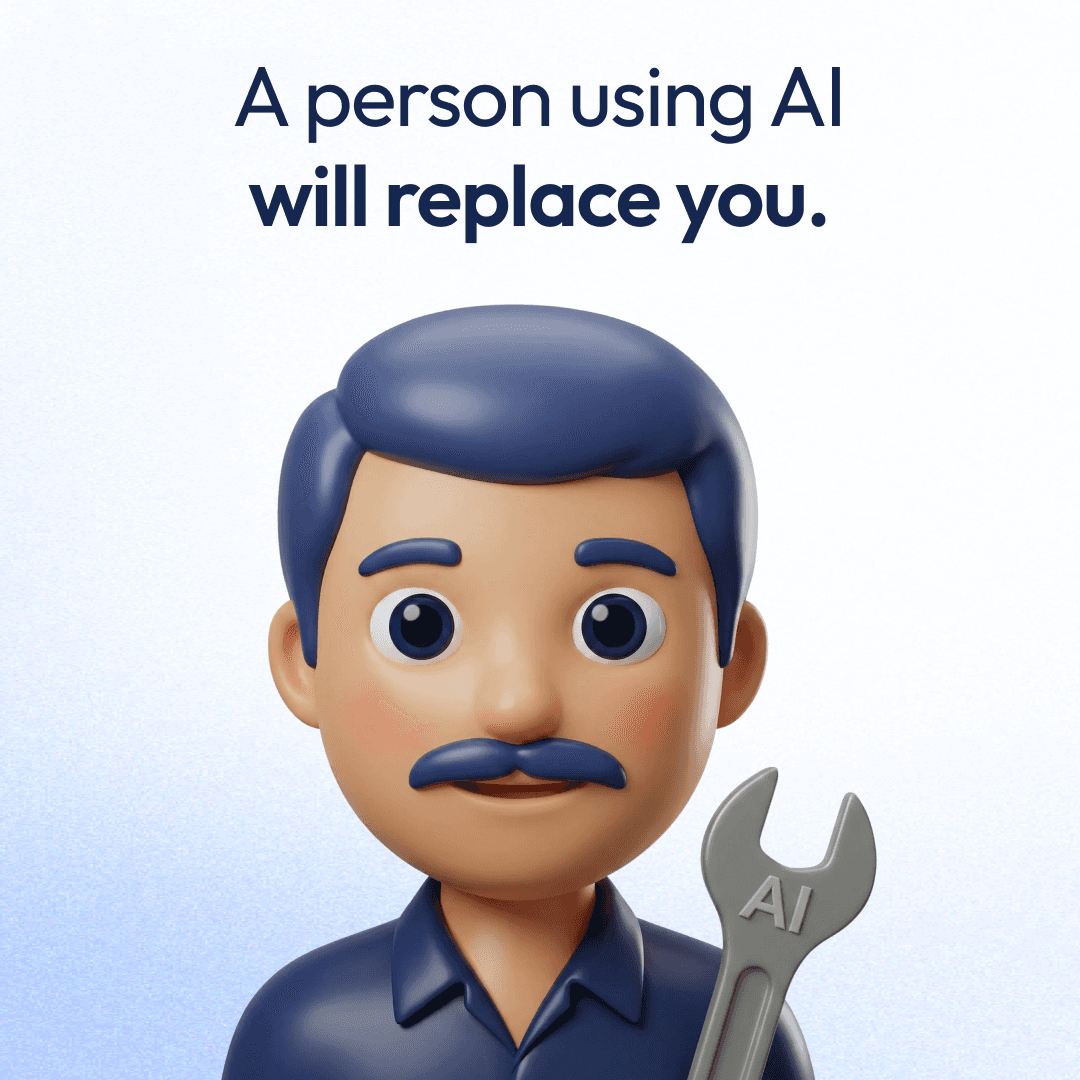

AI will not replace B2B sales professionals. What it does is separate the salespeople and teams using it as leverage from those who are not. The competitive threat in 2026 is not the technology itself. It is your competitor mastering it while you debate whether to adopt it. That gap compounds fast, and it shows up first in pipeline and qualified meetings booked.
Why This Conversation Keeps Getting It Wrong
The fear is understandable. When a tool can write prospecting emails, score leads, and analyze outreach patterns in seconds, it is natural to ask what is left for the human. But that question misframes the dynamic entirely.
The farmer with a tractor did not get replaced by the machine. One farmer had leverage the other lacked. The accountant with spreadsheet software did not disappear. She processed in two hours what used to take two days. The pattern has repeated across every major productivity technology in business history, and AI in B2B sales follows the same logic.
According to McKinsey's 2025 State of AI report, 72% of companies now use AI in at least one business function, up from 55% the year prior. The question for B2B sales teams is no longer whether AI becomes standard practice. It already is. The question is how far behind you are willing to fall before you decide to take it seriously.
What Does AI Actually Do in Outbound Sales?
AI in outbound sales handles the pattern-based, repetitive work that slows human teams down: analyzing response rates across thousands of touchpoints, identifying which prospect profiles engage with which message types, testing subject line variations, and surfacing timing signals that no manual process could track at scale.
What AI does not do is think strategically, read a conversation for subtext, build trust over multiple interactions, or adapt when a campaign needs a fundamentally different approach. Those remain human problems.
At TheShowcase.ai, our AI Twin handles the analytical and personalization layers of outbound prospecting. It identifies which prospects match a client's ideal profile and crafts contextually relevant outreach at a scale no SDR team could replicate manually. But the human team manages every conversation that follows. No prospect ever talks to a bot. The AI finds the fit. Our people build the relationship.
That division of labor is not a compromise. It is the design. You can see how the model works at
How Does AI Create Leverage, Not Replacement?
Leverage in sales means more output from the same input. AI creates leverage in B2B outreach by eliminating the low-value work that consumes most of an SDR's day, freeing the human to focus on judgment, relationship, and strategy.
Here is what that shift looks like in practice:
Manual prospect research that took 45 minutes per contact gets compressed to seconds
Message personalization that required one-to-one effort scales to hundreds of tailored touchpoints
Campaign performance analysis that needed a weekly review cycle becomes a continuous feedback loop
Timing optimization that relied on gut instinct gets replaced by pattern recognition across thousands of data points
The result is not a smaller team doing the same work. It is the same team doing work that was previously impossible at that volume. According to Salesforce's 2025 State of Sales report, high-performing sales teams are 2.8 times more likely to use AI for prospecting and outreach than underperforming teams [VERIFY exact multiplier]. The advantage is measurable and it is widening.
What Skills Matter More When AI Handles the Repetitive Work?
When AI absorbs the pattern-based workload, the human skills that remain become more valuable, not less. This is the counterintuitive outcome most commentary on AI replacement misses entirely.
Strategic thinking matters more when tactical execution is automated. If AI handles the repetitive parts of your prospecting, the person who knows which strategy to run wins. Relationship depth matters more when initial outreach scales through technology. If AI can open a hundred conversations simultaneously, the human who can convert those conversations into genuine trust becomes the critical asset. Creative judgment matters more when standard approaches are commoditized. Everyone will have access to the same AI tools. The advantage comes from using them in ways others have not thought of yet.
These are not soft skills relegated to the bottom of a job description. They are the ceiling on what AI-assisted sales teams can actually achieve. AI raises the floor. Humans determine the ceiling.
This is exactly the model we operate at TheShowcase.ai. Our clients in Sweden and across the Nordics typically book between 15 and 30 qualified meetings per month, not because our AI Twin does everything, but because it does the right things and our team takes it from there.
Why Getting Started Now Matters More Than Getting It Perfect
Experience with new tools compounds. The team that started using AI in their outreach process in 2024 has two years of learning, iteration, and refined judgment that a team starting today does not. Waiting for AI to mature before adopting it is the same logic as waiting for the internet to stabilize before building a website.
The companies winning in B2B outbound right now are not the ones with the most sophisticated AI setup. They are the ones who started earlier, ran more experiments, and built institutional knowledge about what works. That gap is already visible in pipeline quality and close rates.
For companies in the Nordics, this dynamic has a local dimension. The B2B sales landscape in Sweden is relationship-driven and trust-dependent. AI that replaces human contact does not work here. AI that enables better, more relevant human contact does. That is a meaningful distinction if you are choosing how to integrate AI into your outbound process or selecting an outbound sales agency to run it for you.
Common Mistakes to Avoid
Treating AI as a cost-cutting tool rather than a capability multiplier. Teams that deploy AI to reduce headcount rather than expand output consistently underperform. The goal is to do more with the same people, not fewer people doing the same thing.
Automating the relationship-building layer. Prospects notice when the conversation feels scripted or non-human. In B2B sales, particularly in the Nordics, that impression is difficult to recover from. AI should never touch the conversations themselves.
Waiting for internal consensus before experimenting. AI adoption decisions that go through lengthy approval cycles lose six to twelve months of compounding experience. Start small, run a contained test, and let the results make the argument internally.
Measuring AI impact with the wrong metrics. Tracking activity volume (emails sent, connections made) instead of outcome quality (qualified meetings booked, pipeline value generated) leads to misleading conclusions about whether AI is actually working.
Frequently Asked Questions
1. Will AI replace B2B sales jobs?
AI in B2B sales is not replacing salespeople. It is replacing the repetitive, pattern-based parts of the job, such as prospect research, data entry, and message sequencing. The skills that matter most in sales, including strategic judgment, relationship building, and creative problem-solving, become more valuable as AI handles the lower-order work.
2. How is AI used in B2B lead generation today?
In B2B lead generation, AI analyzes large prospect datasets to identify ideal-fit contacts, personalizes outreach messages at scale, tests message variations to improve response rates, and surfaces timing signals that improve engagement. At TheShowcase.ai, our AI Twin handles this layer while our human team manages every prospect conversation directly.
3. What is the difference between AI-powered lead generation and traditional lead generation?
Traditional lead generation relies on manual research, generic messaging, and slow iteration cycles. AI-powered lead generation processes thousands of data points to identify high-fit prospects, personalizes outreach automatically, and optimizes in near real time. The result is a higher proportion of qualified meetings booked per outreach effort, with less wasted activity.
4. Is AI outreach effective in the Swedish and Nordic B2B market?
AI outreach works in the Nordic market when it is used to improve relevance and personalization, not to automate human contact out of the process. Nordic B2B buyers value trust and relationship quality. The most effective model pairs AI-driven prospect identification and personalization with human-managed conversations, which is the model we use at TheShowcase.ai across Sweden and the broader Nordics.
5. How do I know if my sales team is falling behind on AI adoption?
The clearest signal is pipeline efficiency. If your team is generating roughly the same number of qualified meetings as two years ago with the same headcount, while competitors report higher output, the gap is likely AI-driven. According to Salesforce's 2025 State of Sales report, high-performing sales teams are significantly more likely to use AI for prospecting than their lower-performing peers.
Ready to See What AI-Assisted Outreach Actually Produces?
If your outbound process still relies on manual research, generic sequences, and hoping the volume is enough, the results will keep reflecting that. We have built a model that combines AI precision with human relationship-building, and our clients in Sweden and across the Nordics see between 15 and 30 qualified decision-maker meetings booked per month as a result. Book a call with our team at and see what that looks like applied to your specific market and ICP.
AI will not replace B2B sales professionals. What it does is separate the salespeople and teams using it as leverage from those who are not. The competitive threat in 2026 is not the technology itself. It is your competitor mastering it while you debate whether to adopt it. That gap compounds fast, and it shows up first in pipeline and qualified meetings booked.
Why This Conversation Keeps Getting It Wrong
The fear is understandable. When a tool can write prospecting emails, score leads, and analyze outreach patterns in seconds, it is natural to ask what is left for the human. But that question misframes the dynamic entirely.
The farmer with a tractor did not get replaced by the machine. One farmer had leverage the other lacked. The accountant with spreadsheet software did not disappear. She processed in two hours what used to take two days. The pattern has repeated across every major productivity technology in business history, and AI in B2B sales follows the same logic.
According to McKinsey's 2025 State of AI report, 72% of companies now use AI in at least one business function, up from 55% the year prior. The question for B2B sales teams is no longer whether AI becomes standard practice. It already is. The question is how far behind you are willing to fall before you decide to take it seriously.
What Does AI Actually Do in Outbound Sales?
AI in outbound sales handles the pattern-based, repetitive work that slows human teams down: analyzing response rates across thousands of touchpoints, identifying which prospect profiles engage with which message types, testing subject line variations, and surfacing timing signals that no manual process could track at scale.
What AI does not do is think strategically, read a conversation for subtext, build trust over multiple interactions, or adapt when a campaign needs a fundamentally different approach. Those remain human problems.
At TheShowcase.ai, our AI Twin handles the analytical and personalization layers of outbound prospecting. It identifies which prospects match a client's ideal profile and crafts contextually relevant outreach at a scale no SDR team could replicate manually. But the human team manages every conversation that follows. No prospect ever talks to a bot. The AI finds the fit. Our people build the relationship.
That division of labor is not a compromise. It is the design. You can see how the model works at
How Does AI Create Leverage, Not Replacement?
Leverage in sales means more output from the same input. AI creates leverage in B2B outreach by eliminating the low-value work that consumes most of an SDR's day, freeing the human to focus on judgment, relationship, and strategy.
Here is what that shift looks like in practice:
Manual prospect research that took 45 minutes per contact gets compressed to seconds
Message personalization that required one-to-one effort scales to hundreds of tailored touchpoints
Campaign performance analysis that needed a weekly review cycle becomes a continuous feedback loop
Timing optimization that relied on gut instinct gets replaced by pattern recognition across thousands of data points
The result is not a smaller team doing the same work. It is the same team doing work that was previously impossible at that volume. According to Salesforce's 2025 State of Sales report, high-performing sales teams are 2.8 times more likely to use AI for prospecting and outreach than underperforming teams [VERIFY exact multiplier]. The advantage is measurable and it is widening.
What Skills Matter More When AI Handles the Repetitive Work?
When AI absorbs the pattern-based workload, the human skills that remain become more valuable, not less. This is the counterintuitive outcome most commentary on AI replacement misses entirely.
Strategic thinking matters more when tactical execution is automated. If AI handles the repetitive parts of your prospecting, the person who knows which strategy to run wins. Relationship depth matters more when initial outreach scales through technology. If AI can open a hundred conversations simultaneously, the human who can convert those conversations into genuine trust becomes the critical asset. Creative judgment matters more when standard approaches are commoditized. Everyone will have access to the same AI tools. The advantage comes from using them in ways others have not thought of yet.
These are not soft skills relegated to the bottom of a job description. They are the ceiling on what AI-assisted sales teams can actually achieve. AI raises the floor. Humans determine the ceiling.
This is exactly the model we operate at TheShowcase.ai. Our clients in Sweden and across the Nordics typically book between 15 and 30 qualified meetings per month, not because our AI Twin does everything, but because it does the right things and our team takes it from there.
Why Getting Started Now Matters More Than Getting It Perfect
Experience with new tools compounds. The team that started using AI in their outreach process in 2024 has two years of learning, iteration, and refined judgment that a team starting today does not. Waiting for AI to mature before adopting it is the same logic as waiting for the internet to stabilize before building a website.
The companies winning in B2B outbound right now are not the ones with the most sophisticated AI setup. They are the ones who started earlier, ran more experiments, and built institutional knowledge about what works. That gap is already visible in pipeline quality and close rates.
For companies in the Nordics, this dynamic has a local dimension. The B2B sales landscape in Sweden is relationship-driven and trust-dependent. AI that replaces human contact does not work here. AI that enables better, more relevant human contact does. That is a meaningful distinction if you are choosing how to integrate AI into your outbound process or selecting an outbound sales agency to run it for you.
Common Mistakes to Avoid
Treating AI as a cost-cutting tool rather than a capability multiplier. Teams that deploy AI to reduce headcount rather than expand output consistently underperform. The goal is to do more with the same people, not fewer people doing the same thing.
Automating the relationship-building layer. Prospects notice when the conversation feels scripted or non-human. In B2B sales, particularly in the Nordics, that impression is difficult to recover from. AI should never touch the conversations themselves.
Waiting for internal consensus before experimenting. AI adoption decisions that go through lengthy approval cycles lose six to twelve months of compounding experience. Start small, run a contained test, and let the results make the argument internally.
Measuring AI impact with the wrong metrics. Tracking activity volume (emails sent, connections made) instead of outcome quality (qualified meetings booked, pipeline value generated) leads to misleading conclusions about whether AI is actually working.
Frequently Asked Questions
1. Will AI replace B2B sales jobs?
AI in B2B sales is not replacing salespeople. It is replacing the repetitive, pattern-based parts of the job, such as prospect research, data entry, and message sequencing. The skills that matter most in sales, including strategic judgment, relationship building, and creative problem-solving, become more valuable as AI handles the lower-order work.
2. How is AI used in B2B lead generation today?
In B2B lead generation, AI analyzes large prospect datasets to identify ideal-fit contacts, personalizes outreach messages at scale, tests message variations to improve response rates, and surfaces timing signals that improve engagement. At TheShowcase.ai, our AI Twin handles this layer while our human team manages every prospect conversation directly.
3. What is the difference between AI-powered lead generation and traditional lead generation?
Traditional lead generation relies on manual research, generic messaging, and slow iteration cycles. AI-powered lead generation processes thousands of data points to identify high-fit prospects, personalizes outreach automatically, and optimizes in near real time. The result is a higher proportion of qualified meetings booked per outreach effort, with less wasted activity.
4. Is AI outreach effective in the Swedish and Nordic B2B market?
AI outreach works in the Nordic market when it is used to improve relevance and personalization, not to automate human contact out of the process. Nordic B2B buyers value trust and relationship quality. The most effective model pairs AI-driven prospect identification and personalization with human-managed conversations, which is the model we use at TheShowcase.ai across Sweden and the broader Nordics.
5. How do I know if my sales team is falling behind on AI adoption?
The clearest signal is pipeline efficiency. If your team is generating roughly the same number of qualified meetings as two years ago with the same headcount, while competitors report higher output, the gap is likely AI-driven. According to Salesforce's 2025 State of Sales report, high-performing sales teams are significantly more likely to use AI for prospecting than their lower-performing peers.
Ready to See What AI-Assisted Outreach Actually Produces?
If your outbound process still relies on manual research, generic sequences, and hoping the volume is enough, the results will keep reflecting that. We have built a model that combines AI precision with human relationship-building, and our clients in Sweden and across the Nordics see between 15 and 30 qualified decision-maker meetings booked per month as a result. Book a call with our team at and see what that looks like applied to your specific market and ICP.